Bacterial Leaf Scorch (BLS) is a fatal, systemic tree disease caused by the bacterium Xylella fastidiosa. This bacterium clogs the water-conducting tissues of susceptible trees, causing the leaves on red oaks and water oaks to turn brown at the margins and drop prematurely in late summer. While Bacterial Leaf Scorch mimics severe drought stress, the disease returns every year and gradually kills the host tree. Because there is no cure, Midlands property owners must focus on stress reduction and managing hazardous deadwood before the structural integrity of the oak fails.
What is Bacterial Leaf Scorch?
Bacterial Leaf Scorch is a chronic vascular disease that prevents a tree from transporting water to its canopy. As the Xylella fastidiosa bacteria multiply inside the xylem, the restricted water flow causes leaves to brown and die. This condition progressively worsens over a period of three to ten years until the tree dies. According to the Clemson Cooperative Extension, Bacterial Leaf Scorch commonly affects red oaks and water oaks across South Carolina, typically showing initial symptoms in early fall following summer drought.
Beyond red oaks and water oaks, this disease infects pin oaks, sycamores, and elms. The bacterial infection physically blocks the xylem channels. Without water transport, the tree cannot photosynthesize effectively. As the canopy thins year after year, the root system starves, accelerating the tree’s decline.
How does Bacterial Leaf Scorch spread?
Bacterial Leaf Scorch spreads primarily through xylem-feeding insects like leafhoppers and spittlebugs. When these sap-sucking insects feed on an infected tree, the insects acquire the Xylella fastidiosa bacteria and transmit the bacteria to healthy trees during subsequent feedings. Once inside a new host, the bacteria multiply rapidly during the warm South Carolina spring.
Over the 2026 growing season, the bacterial colony grows large enough to completely occlude the stem and leaf petioles, leading to the rapid scorch symptoms seen in August and September. Because these vectors are native and widespread, controlling the insect population with pesticides is not an effective way to stop the disease. The bacteria can also survive the winter in the tree’s roots and lower trunk, moving back up into the canopy when sap flows in the spring.
How do you tell Bacterial Leaf Scorch from drought stress?
Bacterial Leaf Scorch causes an irregular, marginal browning that starts on older leaves near the trunk and progresses outward toward the branch tips. In contrast, environmental drought stress causes even browning that starts on the youngest leaves at the very ends of the branches. Furthermore, Bacterial Leaf Scorch often presents a distinct yellow or reddish halo separating the dead brown tissue from the healthy green tissue.
| Feature | Bacterial Leaf Scorch | Environmental Drought Stress |
|---|---|---|
| Browning Pattern | Irregular, often with a yellow or red halo | Even, uniform browning on all leaf edges |
| Starting Location | Older leaves near the trunk | Youngest leaves at branch tips |
| Canopy Spread | Often attacks one specific branch first | Affects the entire canopy at once |
| Timing | Late summer (July to September) | Any time soil moisture drops significantly |
Can you cure Bacterial Leaf Scorch in oaks?
There is no known cure for Bacterial Leaf Scorch, but property owners can extend a tree’s life by reducing environmental stress. Management strategies include providing supplemental watering during dry periods, applying organic mulch, and pruning out dead branches. Mississippi State University Extension notes that while trunk injections of Oxytetracycline antibiotics can suppress symptoms in high-value landscape trees, the antibiotics do not cure the underlying infection.
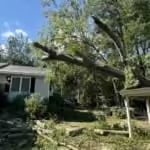
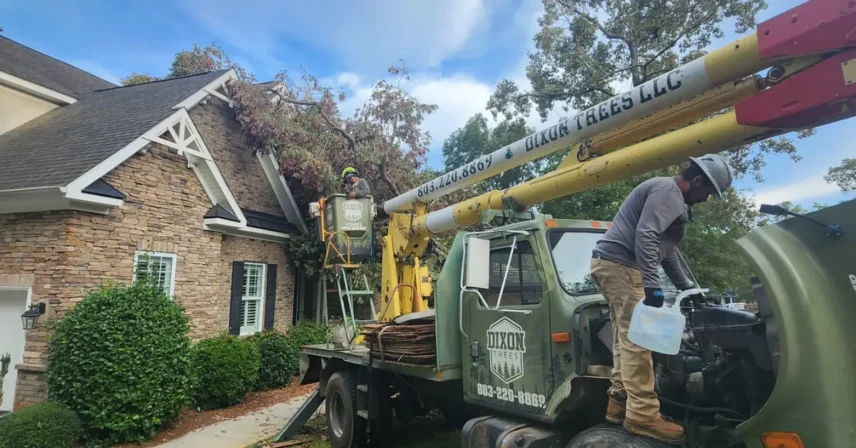
Management focuses on prolonging the tree’s aesthetic value and mitigating safety risks. Watering deeply during dry spells prevents the tree from fighting both the disease and environmental drought simultaneously. Applying a three-inch layer of organic mulch helps retain soil moisture and regulates root temperatures. Because Bacterial Leaf Scorch inevitably causes limb death, routine deadwooding is critical. Because declining oaks drop large limbs, hazardous branches must be removed. If your oak tree has lost more than a third of its canopy, contact Dixon Trees LLC to safely dismantle the hazard. Our 24/7 emergency tree service also handles oaks that fail suddenly during severe Midlands storms.
Bacterial Leaf Scorch in Midlands Oaks: FAQs
Which trees in the Midlands are most at risk?
Red oaks and water oaks are the most commonly affected trees in the Midlands of South Carolina, but Bacterial Leaf Scorch also infects pin oaks, sycamores, and elms. If you have mature oaks on your property that brown early and decline a little more each year, they are the trees most worth watching for symptoms.
When do Bacterial Leaf Scorch symptoms appear?
Symptoms usually show up in late summer and early fall, often in August and September, after the summer drought period. The bacterial colony grows through the warm season until it blocks the stems and leaf stalks, which triggers the sudden scorch you see. A tree can look healthy in spring and brown heavily by the end of summer.
Can Bacterial Leaf Scorch spread to my other trees?
Yes. The disease moves from tree to tree through xylem-feeding insects like leafhoppers and spittlebugs, so a nearby healthy oak can become infected over time. Because these insects are native and everywhere, pesticides will not reliably stop the spread. Keeping your other oaks well watered and low-stress is a better way to slow it.
When should an oak with Bacterial Leaf Scorch be removed?
Removal becomes the priority once the tree turns into a safety risk rather than just an eyesore. A good rule is that an oak which has lost more than a third of its canopy, or is dropping large dead limbs, should be assessed for removal. Declining oaks fail suddenly in Midlands storms, so do not wait for a limb to come down first.
Does removing an infected tree protect my nearby oaks?
It can lower the local source of bacteria, but it is not a guaranteed fix, because infected trees elsewhere in the area and the insects that feed on them can still carry the disease. The main reason to remove a scorched oak is safety once it is declining. Protecting your remaining oaks comes down to reducing their stress and monitoring them each year.
Is a tree with Bacterial Leaf Scorch dangerous?
The disease itself is not harmful to people or pets, but the dead and weakened limbs it leaves behind are a real hazard. As the canopy thins year after year, the oak drops large branches and can fail at the trunk, especially in a storm. That falling deadwood over a home, driveway, or walkway is the danger that needs managing.
How long will my oak survive after it is diagnosed?
Bacterial Leaf Scorch is slow but fatal. Most infected oaks decline over a period of three to ten years before the tree dies, with the canopy thinning a little more each season. Stress reduction through watering, mulching, and pruning can prolong the tree’s life and appearance, but it does not stop the underlying infection.