Yes, if you live outside city limits in Lexington County, South Carolina law requires you to notify the SC Forestry Commission before burning limbs, leaves, or yard debris. Inside city limits, burning yard debris is generally prohibited or heavily restricted by local ordinances. Making the required notification logs your fire with emergency dispatch, preventing local fire departments from responding to false alarms. Failure to follow the notification rules can result in fines and liability for firefighting costs if the fire escapes.
What are the rules for burning yard debris in Lexington County?
Lexington County residents must clear the burn site to bare soil, stay with the fire until the fire is completely extinguished, and possess adequate tools to control the blaze. The Lexington County Fire Services outdoor burning ordinance strictly limits burning to natural vegetation, such as limbs and leaves, grown on the property where the burn occurs.
- Material restrictions: Only natural yard waste grown on the property can be burned. Burning dimensional lumber, household trash, or tires is a violation of environmental regulations.
- Clearance zones: The fire must be located safely away from woodlands, property lines, and residential structures.
- Fire containment: The area around the fire must be cleared down to mineral soil to prevent ground spread.
- Supervision: A responsible adult must stay with the fire until the embers are completely cold.
Additionally, open burning must occur during daylight hours and must not create a smoke nuisance for public roads or neighbors.
How do you notify the SC Forestry Commission?
You notify the SC Forestry Commission by calling their toll-free automated dispatch number at 1-800-705-8613 before you ignite the fire. The automated system will ask for your phone number, county, and the specific location of the burn site. According to the South Carolina Forestry Commission, this state law applies specifically to residential yard debris; larger land clearing fires require a different permit and specialized equipment.
The notification process is entirely free and takes less than two minutes. The state requires this notification to track active residential burns. Without this log, passing drivers often report smoke columns to 911. When local fire crews deploy to unnotified fires, it wastes municipal resources and takes emergency responders away from genuine structural fires. Keep the notification number provided by the automated system written down. If a forestry warden or local fire marshal visits your property, providing the notification number proves you followed the legal process.
What happens during a Red Flag Fire Alert or burn ban?
During a Red Flag Fire Alert or a locally declared burn ban, all outdoor burning is strictly prohibited, including yard debris fires and campfires. The SC Forestry Commission issues these alerts when low humidity, dry vegetation, and gusty winds create conditions where fires can easily escape control. In 2026, checking the daily fire weather forecast is essential, as starting a fire during a ban carries criminal penalties.
South Carolina historically experiences a high volume of wildfires during the spring months. When a cold front drops relative humidity below critical thresholds and brings high winds, wind can carry hot embers hundreds of feet into dry brush. Escaped yard debris fires remain a leading cause of wildfires in the state. If you ignite a fire during a ban and it damages neighboring property, you are legally and financially liable for the destruction and the suppression costs.
What are the safest alternatives to burning tree limbs?
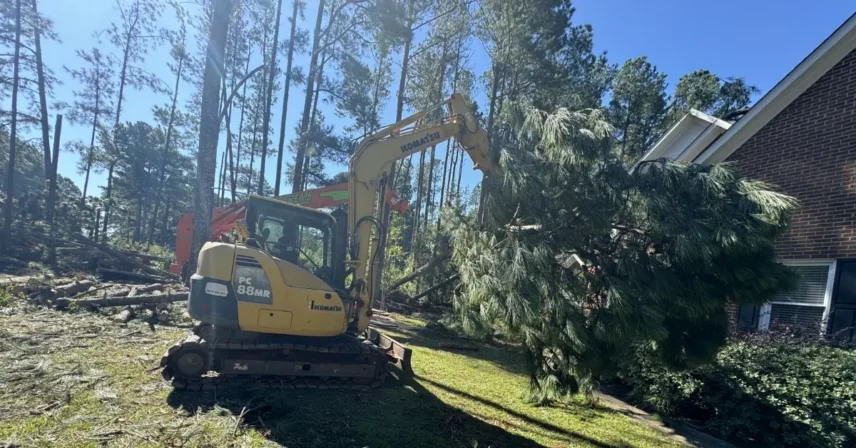
The safest alternatives to burning tree limbs include on-site chipping, hauling the debris to a permitted landfill, or hiring a professional tree service. Chipping eliminates fire risk entirely while creating valuable mulch for garden beds. For large volumes of brush or downed trees, professional lot clearing is far safer and faster than managing a large burn pile.
Many suburban neighborhoods in the Midlands are too densely populated for safe open burning. The resulting woodchips from a chipper suppress weeds and retain moisture when applied around trees and shrubs. For property owners clearing entire lots or dealing with massive storm cleanups, mechanical land clearing offers immediate results without smoke or fire risks. If you are overwhelmed by downed limbs, rely on professional tree services to clear your property safely and legally.
Burning Limbs in Lexington County: FAQs
Do I need to notify the SC Forestry Commission before burning limbs in Lexington County?
Yes. If you live outside city limits in Lexington County, South Carolina law requires you to notify the SC Forestry Commission before burning limbs, leaves, or yard debris. The notification logs your fire with emergency dispatch so fire crews are not sent out for a false alarm. Skipping it can bring fines and liability if the fire escapes.
Can I burn yard debris inside city limits?
Generally no. Inside city limits, burning yard debris is usually prohibited or heavily restricted by local ordinances, so you cannot rely on the county notification process alone. If you live in or near a town center in the Midlands, check your local rules first, and plan on chipping or hauling the debris instead of burning it.
How much does it cost to notify, and what number do I call?
Nothing. The notification is completely free and takes less than two minutes. You call the SC Forestry Commission toll-free automated line at 1-800-705-8613 before you light the fire, and the system asks for your phone number, county, and the exact burn location. Write down the number the system gives you as proof you followed the process.
What am I actually allowed to burn?
Only natural yard waste grown on the property where the burn happens, such as limbs and leaves. Burning dimensional lumber, household trash, or tires is an environmental violation. The fire must sit well away from woodlands, property lines, and structures, on ground cleared to bare mineral soil, with a responsible adult staying until the embers are completely cold.
Can I burn limbs at night?
No. Open burning must happen during daylight hours, and it must not create a smoke nuisance for public roads or your neighbors. Night burning is not permitted, partly because smoke and embers are harder to monitor in the dark. Plan your burn for a calm daytime window when winds are light and visibility is good.
How do I know if there is a burn ban in effect today?
Check the daily fire weather forecast before you burn. During a Red Flag Fire Alert or a locally declared burn ban, all outdoor burning is prohibited, including yard debris fires and campfires. These alerts go out when low humidity, dry vegetation, and gusty winds make fires easy to lose control of, and burning during a ban carries criminal penalties.
What happens if my fire escapes or I burn without notifying?
You can be held legally and financially liable. If a fire you started damages a neighbor’s property, you are responsible for the destruction and the firefighting costs, and burning during a ban adds criminal penalties on top. Escaped yard debris fires are a leading cause of wildfires in South Carolina, which is why the notification and safety rules are enforced.