Some trees can be saved. A large oak with a weak fork in the trunk doesn’t have to come down- it can often be cabled and braced, keeping the tree standing safely for decades. Cabling and bracing is one of the most underused services in the tree care industry, and it’s one of the things that separates a real arborist company from a chainsaw operation.
Dixon Trees LLC offers professional cabling and bracing services throughout Lexington and the Midlands. Our work follows ANSI A300 Part 3 standards and is performed by ISA-trained personnel.
Call (803) 598-3888 for a free estimate.
What is Tree Cabling and Bracing?
Cabling involves installing high-strength steel cable between two limbs (or between a limb and the trunk) high in the canopy. The cable doesn’t carry weight under normal conditions- it only engages when wind or load tries to pull the weak point apart. Think of it as a backup system that prevents catastrophic failure at structurally weak points.
Bracing involves installing threaded steel rods through a weak union, mechanically reinforcing the connection from the inside. It’s used in cases where the union is already starting to split, or where the structural weakness is too severe for cabling alone.
The two are often used together. A large tree with a problematic codominant stem might get a brace rod through the union and a cable installed higher up to reduce stress on the entire structure.
When Cabling and Bracing Make Sense
Not every weak tree is a candidate. We use cabling and bracing when:
- The tree is otherwise healthy and worth preserving.
- The structural defect can be effectively reinforced by cables or rods.
- The tree has significant value- shade, mature size, sentimental, or property value.
- Removal isn’t desired or isn’t necessary if the structure can be stabilized.
Common trees that need cabling in Lexington and the Midlands include:
- Large oaks with codominant stems- two main trunks growing from one base.
- Mature hardwoods with included bark at a major fork.
- Trees with long heavy lateral limbs that are over-leveraged.
- Storm-damaged trees with cracked unions that can be saved if reinforced.
- Historic or specimen trees where removal would be a significant loss.
How the Installation Works
Site evaluation
An ISA-trained arborist looks at the tree, identifies the structural weakness, evaluates the overall tree health, and determines whether cabling, bracing, or both are appropriate. This is a real evaluation, not a sales pitch.
Hardware selection and placement
Cable and rod sizing depend on the size of the tree, the load expected, and the location of the installation. We use galvanized steel hardware sized according to ANSI A300 standards. Cable goes high in the canopy- typically two-thirds of the way up the limb being supported. Rods go through the weak union, drilled and tapped to industry specification.
Installation
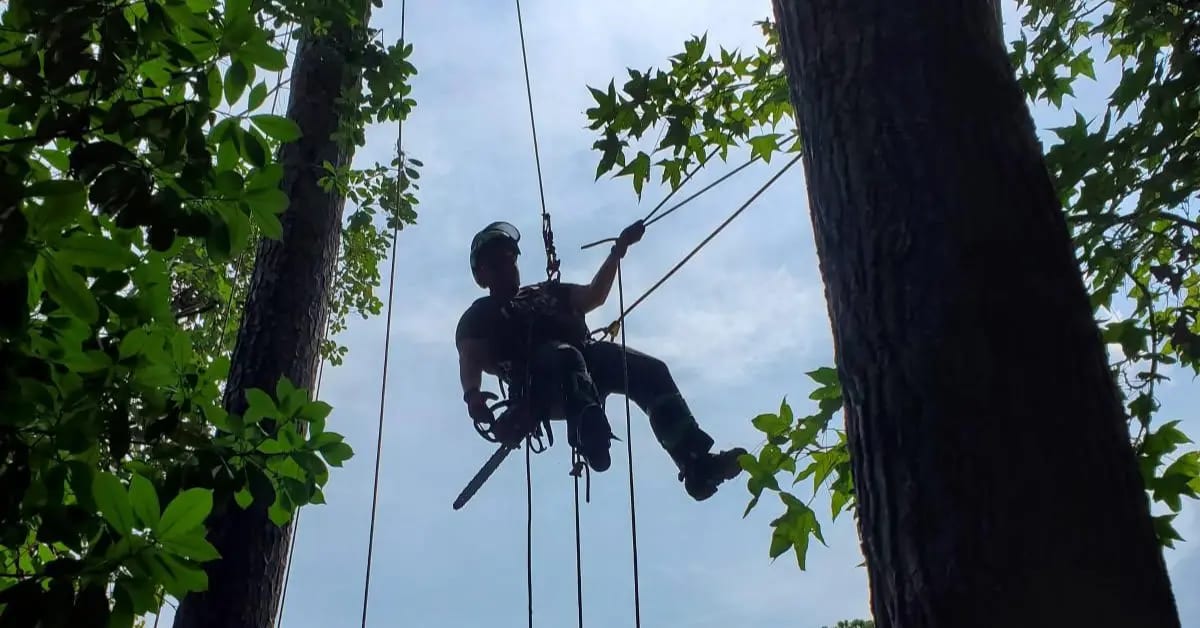
Our climbers install the hardware using proper tree-friendly attachment methods. Drilling is done cleanly, anchors are placed in sound wood, and cables are tensioned correctly- tight enough to engage when needed, loose enough to allow normal flex.
Documentation and follow-up
After installation, we document the hardware locations and provide you with a maintenance schedule. Cables should be inspected every few years, and we offer follow-up inspections to make sure everything’s still working as it should.
How Long Does Cabling Last?
Cables and bracing rods, properly installed in healthy wood, can last 20 to 30 years or more. The hardware itself is galvanized steel sized to outlast the tree in most cases. What does need attention is the inspection- over time, the tree grows around the hardware, and we need to check that everything is still functioning as intended and that the wood around the anchor points is sound.
We recommend an inspection every 3 to 5 years on cabled trees. The inspection is fast- usually 15 to 30 minutes- and lets us catch any issues before they become a problem. If a cable has loosened, if an anchor has shifted, or if the tree has grown in a way that requires adjustment, we can handle it during a scheduled visit instead of after a failure.
Cabling and Bracing Standards
This is one of the most technical types of tree work, and it’s also one of the easiest places for an unskilled crew to do real damage. Hardware installed in the wrong location, sized incorrectly, or anchored in decaying wood can give homeowners a false sense of security- the tree looks supported but is actually no safer than before. Worst case, the hardware itself can fail and cause additional damage when it lets go.
Professional cabling and bracing follows ANSI A300 Part 3 standards. That includes specifications for hardware sizing, anchor placement, drilling techniques, tensioning, and documentation. Our crews follow these standards on every installation, and we use the same hardware specifications regardless of whether the customer is asking about it or not. It’s how the work is supposed to be done.
Why Choose Us?
Tree work is dangerous, and accreditation in this industry isn’t easy to come by. Dixon Trees LLC holds the credentials that actually matter:
- TCIA Accredited- Tree Care Industry Association accreditation, held by less than 2% of tree companies nationally.
- ISA Member- International Society of Arboriculture membership and standards.
- OSHA Certified- federal occupational safety certification on every crew.
- BBB A+ Rated- Better Business Bureau accredited with an A+ rating.
- Licensed, Bonded, and Insured- full general liability, workers’ comp, and bonding.