Lexington summers are hard on trees. Daytime highs in the mid-90s for weeks at a time. Humidity that doesn’t let off. Long stretches without rain interrupted by sudden inch-and-a-half thunderstorms. Soil that swings from cracked-clay dry to fully saturated in the same week. By August, trees that looked fine in May are showing real stress- leaf scorch, dieback at the tips, premature leaf drop, fungal growth at the base.
Most of that damage is preventable, or at least manageable, if you know what to look for and what to do about it. Here’s a practical guide to keeping the trees on your Lexington property alive and healthy through the worst of the summer.
Water Right, Not Often
The single most common summer mistake is wrong watering- either not enough, or shallow daily watering that creates more problems than it solves.
Mature trees in Lexington usually don’t need supplemental water unless we’re in a serious drought, but when they do, the rules are:
- Water deeply, not frequently. A long soak once a week beats a light sprinkle every day. You want the water to penetrate 10 to 12 inches down, which is where the feeder roots are.
- Water at the drip line, not at the trunk. The drip line is the edge of the canopy- that’s where most of the absorbing roots actually live. Watering right against the trunk does nothing for the tree and can actually rot the bark over time.
- Water early morning or evening, not midday. Less evaporation, more goes to the tree.
- A slow-running hose or soaker hose at the drip line for 45 to 60 minutes is usually plenty for one mature tree. For multiple trees, a soaker hose around the canopy edge works well.
Young trees (under five years in the ground) need more attention. A new tree planted in spring will struggle through its first Lexington summer without regular watering- usually twice a week, deep soaks. If the leaves are wilting in the afternoon and not recovering by morning, you’re behind.
Mulch- But Not a Mulch Volcano
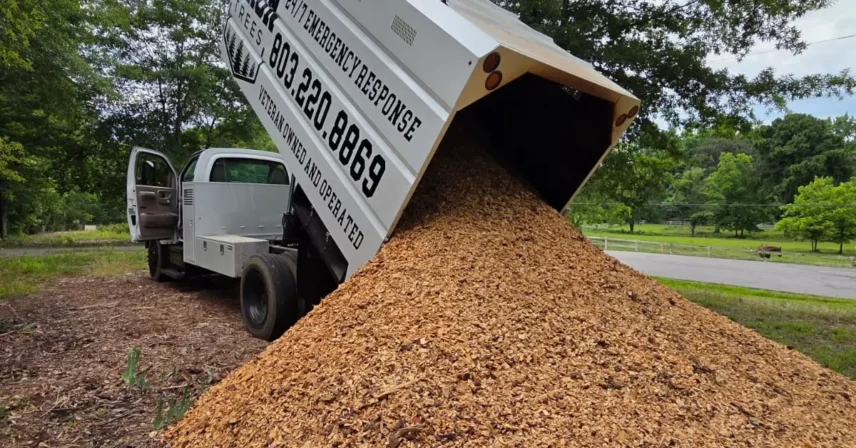
Mulch is one of the cheapest, most effective summer protections you can give a tree. A 3 to 4 inch layer around the base does several things at once- holds moisture in the soil, moderates root-zone temperature, suppresses competing weeds and grass, and slowly improves the soil as it breaks down.
Two rules that matter:
- Spread the mulch out to the drip line if possible, not just in a small circle around the trunk.
- Keep mulch away from the trunk itself. Piling mulch up against the bark- the “mulch volcano” you see all over Lexington landscaping- traps moisture against the trunk, invites fungus, and can kill the tree over a few years. Leave a 3 to 4 inch gap between the mulch and the bark.
Pine bark, hardwood chips, or composted leaf mulch all work. Refresh once a year, usually in spring.
Watch for Heat and Drought Stress
Trees can’t tell you they’re stressed in words, but they show it pretty clearly if you know what to look for. Warning signs that show up during a hot Midlands summer:
- Leaf scorch- leaf edges turning brown and crispy, especially on the sun-facing side of the tree.
- Premature leaf drop- leaves yellowing and falling in July or August instead of October.
- Wilting that doesn’t recover overnight.
- Twig and branch dieback at the canopy edges.
- Cracks opening in the bark on the sunny side of the trunk (sunscald).
- Fewer, smaller leaves than the tree had last year.
Light stress is normal in a Lexington summer and most trees recover fine. Heavy stress- especially when it shows up two or three summers in a row- is a sign the tree needs intervention. Sometimes that’s deep watering and mulch. Sometimes it’s removing competing vegetation. Sometimes it’s a deeper soil or root issue that needs an arborist to evaluate.
Don’t Prune in the Heat (With One Exception)
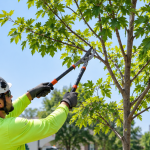
Heavy pruning during the heat of summer stresses trees. They’re already working hard to move water from saturated or drying soil to a full canopy of leaves; cutting branches mid-season forces the tree to spend reserves it doesn’t have. Save the structural pruning for late winter when the trees are dormant.
The exception: dead, broken, or hazardous limbs. Those come out any time of year, as soon as you spot them. A storm-damaged limb left hanging through summer is a falling object waiting for the next gust, and dead branches in the canopy are the first things to fail in a thunderstorm. For those, call as soon as you notice them- don’t wait for winter.
Important note for Lexington: oaks should never be pruned between April and October. Pruning oaks during the growing season exposes them to oak wilt, a fungal disease spread by beetles attracted to fresh cuts. If you’ve got oaks that need work, schedule it for November through February.
Pests and Diseases to Watch For
Midlands summers are peak season for several tree pests and diseases. The ones worth knowing about:
- Southern pine bark beetle. Attacks stressed pines, especially loblolly. Look for popcorn-sized pitch tubes on the trunk, fading green needles, and small entrance holes. Once established, the tree usually can’t be saved.
- Ambrosia beetles. Attack hardwoods, often after stress events. Look for tiny holes in the bark with thin sawdust-like material protruding like toothpicks.
- Oak wilt. Spread by beetles attracted to fresh wounds, especially on red oaks. Leaves wilt and drop from the top of the canopy down. Almost always fatal once established.
- Anthracnose. A fungal disease that hits sycamores and dogwoods hard during wet springs. Causes leaf spotting, premature defoliation, and twig dieback. Rarely fatal but ugly.
- Spider mites. Pine and spruce trees in dry, hot conditions can get heavy spider mite infestations. Foliage looks dusty or bronze, and tiny webs may be visible.
If you spot any of these on a valuable tree, get it looked at quickly. Some are treatable if caught early. Some aren’t. An arborist can tell the difference.
Storm Prep Before the Next Thunderstorm Hits
Most catastrophic tree failures during summer thunderstorms in the Midlands could have been prevented with tree maintenance plans done weeks or months earlier. Things worth doing before the next storm:
- Walk every major tree on your property and look up. Identify dead branches over 2 inches in diameter- those are the first things to fall.
- Look for weak branch unions, especially tight V-shaped forks with bark turned inward. These fail in microbursts.
- Check for trees that have started leaning since last year, or freshly exposed roots on the upwind side.
- Note any large limbs overhanging the house, the driveway, or where you park your car.
- For trees that have any of the above, get a professional evaluation. A tree with multiple warning signs is a storm-damaged tree waiting to happen.
When to Call a Professional
Some summer tree maintenance is genuinely DIY- mulching, watering, picking up small fallen limbs. A lot of it isn’t. Get a professional out when you see:
- Mushrooms or fungal conks growing on the trunk or at the base.
- Soft, hollow, or rotted-feeling spots in the trunk.
- Vertical cracks running up the trunk or through a major union.
- Limbs over 3 inches in diameter that are dead, damaged, or hanging.
- Trees touching power lines or scraping the house.
- A tree that’s started leaning that wasn’t leaning before.
- Anything close enough to a structure that, if it failed, it would do real damage.
A free arborist evaluation costs nothing and usually catches issues early enough to fix them cheaply.
Get an Evaluation
Dixon Trees LLC offers free on-site, virtual, and phone estimates across Lexington and the surrounding Midlands. We can walk your property, identify the trees that need attention this summer, and tell you straight what needs to happen now versus what can wait until winter.