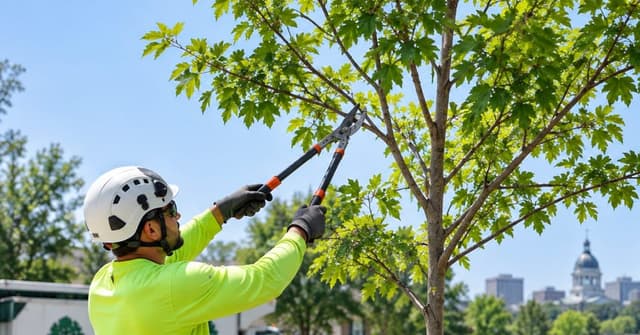
Young trees in Columbia, SC require early structural pruning because their first few years are when their permanent structure is being established. Pruning during this window allows arborists to correct problems such as codominant stems, weak branch unions, included bark, and crossing or rubbing limbs in the early stages when the branches are still small.
What Structural Pruning Actually Does
Early structural pruning prevents major defects, reduces future pruning needs, and helps young trees develop a stronger framework with well-spaced branches. It also improves storm resistance, minimizes large wounds, and supports healthier long-term growth.
For most trees, pruning within the first one to three years, followed by regular inspections, helps address problems early with a few small, strategic cuts instead of larger cuts later.
Why Timing Matters
A one-inch branch cut on a three-year-old tree heals in a season and leaves almost no trace. That same branch, left uncorrected for fifteen years, becomes a four-inch limb. Removing it then leaves a large wound, a slower healing process, and a bigger entry point for decay. The math only gets worse with time.
Young trees also respond to pruning by redirecting energy exactly where you want it. Toward the leader and the branches you keep. Not toward a weak structure you’ll eventually have to remove anyway. That’s a small window most homeowners don’t realize they have.
Common Young-Tree Defects
Three defects show up constantly in Columbia yards. All three are easy to fix young and hard to fix mature.
- Codominant stems are two trunks of roughly equal size competing for dominance. They create a weak, narrow union that’s prone to splitting. Removing one while the tree is young lets the other take over cleanly.
- Included bark is where bark gets pinched inside a tight branch union instead of forming a solid wood connection. It weakens that joint permanently unless it’s corrected before the branches thicken.
- Crossing or rubbing limbs wear through each other’s bark over time, creating wounds that invite decay. A quick, early cut on one of the two branches solves it for good.
Left alone, these defects don’t go away. They just get bigger and more expensive to manage. A tree with a mature codominant stem often needs cabling and bracing just to stay safe. That’s a support system that early structural pruning could have made unnecessary in the first place.
Which Species Need Extra Attention in Early Stages
Some species common in Columbia yards need earlier and more frequent structural pruning than others. This includes –
- Fast-growing trees like Willow Oak put on growth quickly. Defects can set in faster if they’re not caught within the first couple of years.
- Crepe Myrtles are a special case. They’re often pruned incorrectly from a young age, and correcting that early prevents the tree from ever developing the thick, stubby “crape murder” cuts that weaken the wood and shorten bloom quality for years afterward.
- Live Oaks and other long-lived hardwoods grow more slowly, which actually works in a homeowner’s favor. There’s a wider window to catch and correct structural issues before they set. Regardless of species, the principle stays the same: smaller cuts now beat bigger cuts later.
Consequences of Skipping Early Structural Pruning
An unpruned young tree doesn’t fail immediately. It just grows into its defects. Codominant stems widen into major structural weaknesses. Low, poorly spaced branches stay in the final canopy, creating crowding and shade competition that stunts the tree’s overall form. By the time the tree is mature, those same problems that would have taken one small cut to fix now require significant, sometimes risky work. Or they simply become the reason a storm takes half the canopy down.
What Structural Pruning Means for a New Planting on Your Property
If you’ve recently planted a tree, or you’re considering one, structural pruning should be part of the plan from the start. Not an afterthought years down the road. Building a pruning schedule into your first few years of ownership means fewer surprises later. No sudden discovery of a weak union hidden in a canopy you can no longer easily reach. It also tends to mean a healthier-looking tree overall, since a well-structured canopy channels the tree’s energy efficiently instead of wasting it on competing leaders.
Focus Areas During a Young-Tree Inspection
During a young-tree structural assessment, a professional tree service company in Columbia, SC looks at three key areas:
- Is there a single dominant leader?
- Are the main branches properly spaced along the trunk rather than clustered together?
- Do any branch unions have tight angles or signs of included bark?
The goal is not to shape the tree for cosmetic reasons. It is to identify structural problems while they can still be corrected with small, selective cuts. Most young trees need only a few targeted pruning cuts rather than extensive reshaping. Early structural pruning helps establish a strong branch framework that can support the tree as it matures.oint. Structural pruning done right on a young tree is subtle work now that prevents obvious problems later.
How Often Young Trees Need Structural Pruning
Structural pruning for young trees should begin once the tree has established enough growth to identify developing branch structure. The timing can vary based on the tree’s species, condition, growth rate, and structure. At planting, pruning is generally limited to removing broken, damaged, or dead branches so the tree keeps as much healthy leaf area as possible.
Once structural pruning begins, follow-up visits can be scheduled as needed while the tree develops. Pruning should remain light, with the goal of correcting developing structural problems before they become larger issues.
Late winter, before spring growth begins, can be a practical pruning window for many Midlands species because the branch structure is easier to see without leaves. However, the appropriate timing depends on the species and the reason for pruning.
Some trees require different timing. Oaks, for example, may need to be pruned outside periods when oak wilt transmission risk is higher. Spring-flowering trees such as dogwood and redbud are often pruned after flowering when preserving their blooms is a priority.
FAQ: Structural Pruning for Young Trees
At what age should a tree get its first structural pruning?
Most trees benefit from their first structural pruning within one to three years of planting, once they’ve established roots and begun putting on real growth. Waiting much longer means correcting defects that have already started to set into the tree’s permanent form.
Does structural pruning hurt or slow down a young tree’s growth?
Proper structural pruning should not significantly slow a healthy young tree’s growth when only a small amount of live growth is removed. The goal is to correct developing branch defects while preserving enough healthy foliage for continued growth. By addressing structural problems early, pruning can help the tree develop a stronger, better-spaced branch framework as it matures.
Can I do structural pruning myself?
Small, early cuts on very young trees are sometimes manageable for homeowners. Identifying which branch to remove in a codominant stem or included-bark union takes training most people don’t have. A wrong cut can lock in the exact defect you’re trying to prevent.
How much does structural pruning cost for a young tree?
Costs are generally lower than mature tree pruning, since the work involves smaller cuts and less time. The most accurate number comes from a free estimate, where we can look at your specific tree and species.
Which Columbia SC trees benefit most from early structural pruning?
Fast-growing species like Willow Oak put on growth quickly, so early pruning catches defects before they set. Crepe Myrtle and Bradford Pear also benefit especially from early correction, since both are prone to weak branch unions.
Request Young Tree Structural Pruning in Columbia and Lexington, South Carolina
Dixon Trees LLC offers professional structural pruning services across Lexington, Columbia, and surrounding Midlands communities. Operating strictly under ANSI A300 pruning standards, our TCIA-accredited and ISA-member team evaluates young trees to correct codominant stems, eliminate weak unions, and develop well-spaced scaffold branches around a single dominant leader. This essential early care builds natural storm resistance, prevents permanent structural defects, and extends the overall life and value of your trees for decades.
By scheduling light structural pruning every year or two during a tree’s first decade, property owners can avoid costly damage and aggressive corrections down the road. Contact our veteran-owned team at (803) 598-3888 to schedule a free on-site arborist evaluation and protect your landscape’s long-term growth.