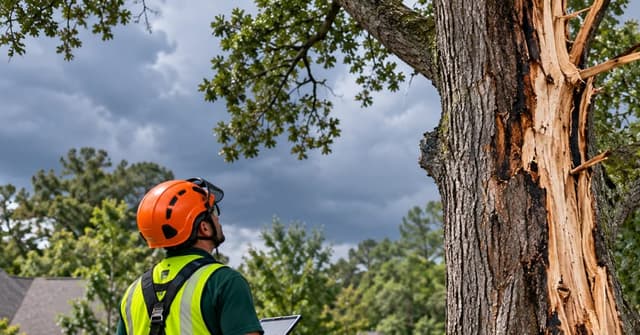
When lightning strikes a tree, the electrical current travels through moist tissues beneath the bark, rapidly heating the sap and water inside. The resulting steam pressure can split the bark and wood, often leaving a visible spiral scar along the trunk. The strike can also destroy the cambium, disrupting the tree’s ability to transport water and nutrients, while damaging roots where the current reaches the ground. Some trees die quickly, while others survive with hidden internal damage. In some cases, decline may not appear for one to three years as decay fungi and bark beetles take advantage of the weakened tissue.
Why Trees Are Struck So Often
Trees are frequently the tallest object in an area, and they contain a great deal of moisture. Both factors make them a preferred path to ground.
According to the National Weather Service , Columbia, South Carolina ranks among the most lightning-prone states in the country, and the Midlands sees heavy convective activity through summer. That makes lightning damage a routine part of tree care in Columbia and Lexington rather than a rare curiosity.
Certain trees are struck more often than others:
- Tall, isolated specimens in open yards
- Trees on high ground
- Species with high moisture content and deep root systems, including oak, poplar, pine, maple, and elm
- Trees near water or near buried metal
- Beech and birch, with smoother bark that sheds water down the outside, are historically struck less often.
What Physically Happens During the Strike
The current takes the path of least resistance. In a tree that is usually the cambium and outer sapwood, where moisture content is highest. Temperatures in that channel rise extraordinarily fast. Water in the cells converts to steam and expands violently. The result is the classic lightning scar: a strip of bark blown off in a spiral or vertical line, sometimes with wood fragments thrown many feet.
The damage does not stop at the trunk. Current continues into the root system and dissipates into the soil. Root damage is invisible from above but frequently determines whether the tree recovers. Sometimes the strike travels down the inside instead. Internal steam pressure can split the trunk from within or, in extreme cases, shatter the tree entirely.
Damage You Can See and Damage You Cannot
Visible indicators are useful but incomplete.
Common signs of lightning damage include:
- A spiral or vertical strip of missing bark running down the trunk
- Splintered wood, cracks, or bark fragments scattered on the ground
- Scorching or blackened tissue near the entry point
- Sudden wilting or browning of the canopy within days
- Sap flow or oozing along the damaged strip
- Soil disturbance or heaving over the root zone where current exited
The problem is that a significant number of strikes leave almost nothing visible. The cambium is dead beneath intact bark. The tree looks entirely normal through the rest of the season.
Decline then appears the following spring as delayed or sparse leaf-out, dieback in the upper canopy, or a thinning crown on one side of the tree. This is why a known strike should trigger an inspection even when the tree appears untouched.
Will the Tree Survive?
Survival depends primarily on how much of the trunk circumference lost living cambium. A single narrow strip of damage on one side is often survivable. The remaining cambium continues moving water and nutrients, and the tree gradually compartmentalizes the wound and grows over it.
Damage extending around a large portion of the circumference is far more serious. If the tree is effectively girdled, the canopy above the damage cannot be sustained and decline is inevitable.
Other factors matter as well:
- The tree’s health and energy reserves before the strike
- Species tolerance
- Whether the root system was damaged
- Whether decay fungi and beetles find the wound
- How much additional stress the tree faces from heat, drought, or construction in the following seasons
The honest answer to whether a struck tree will live is usually that it will take a growing season to find out.
The Real Killer Is What Comes Next
Most lightning-damaged trees do not die from the strike itself. They die from what the strike invited in. A large open wound with dead tissue is an ideal entry point for decay fungi. Those fungi work into the trunk and weaken it structurally over years, often producing conks at the base long after anyone remembers the storm.
Bark beetles and ambrosia beetles are the faster threat. Stressed trees release chemical signals that beetles detect, and a struck pine in a Midlands summer can be colonized within weeks. Southern pine beetle activity following lightning strikes is well documented.
The consequence for property owners is structural. A tree with an expanding internal decay column becomes a hazard whether or not its canopy still looks healthy. Our tree cabling and bracing service can retain some compromised trees, but only where the remaining wood is sound enough to support the hardware.
What to Do Immediately After a Strike
Safety first. Do not approach a struck tree during an ongoing storm. Lightning can strike the same location again, and fragments may still be falling.
Once conditions are safe, take these steps:
- Inspect from a distance for hanging limbs, cracked stems, and fallen debris.
- Keep people and vehicles clear of the area under the canopy until it is assessed.
- Photograph the damage for insurance documentation.
- Check nearby structures, fences, and utility connections for collateral damage.
- Call a qualified arborist rather than deciding immediately to remove the tree.
- Contact your insurer, since lightning damage is covered under many homeowners policies.
If limbs are hanging over a house, driveway, or walkway, that is an emergency regardless of whether the tree ultimately survives. Our 24/7 emergency tree service handles exactly this situation, with a live person answering the phone at any hour.
Caring for a Struck Tree Over the Following Year
Resist the urge to intervene aggressively. Several long-standing folk remedies do more harm than good.
What Not to Do
- Do not apply wound paint or tar. It traps moisture and slows compartmentalization.
- Do not remove loose bark beyond what is clearly detached and hazardous.
- Do not fertilize heavily. Forcing growth on a damaged tree depletes reserves further.
- Do not prune the canopy hard immediately. Wait until the extent of dieback is clear.
What You Should Do
- Do water during dry periods, since drought stress compounds strike injury.
- Do maintain a wide, shallow mulch ring, kept away from the trunk itself.
- Remove clearly dead or hanging limbs for safety, then wait.
By the end of the next growing season, the tree’s trajectory is usually obvious. The International Society of Arboriculture (ISA) offers general guidance on storm-damaged tree recovery that aligns with this approach.
When Removal Is the Right Call
Removal becomes appropriate when the trunk is split, when a large portion of the circumference has lost cambium, when significant decay is already evident, when the root plate has shifted, or when the tree is close enough to a structure that failure would be costly.
A tree in the middle of a field can often be left to decline naturally and provide wildlife habitat. The same tree ten feet from a bedroom is a different decision entirely. Risk is always a function of what is beneath the tree.
Clemson Cooperative Extension publishes South Carolina-specific guidance on assessing storm-damaged trees that homeowners may find useful alongside a professional evaluation.
Can Lightning Protection Be Installed?
Yes. Lightning protection systems for trees have been used for well over a century. A copper conductor runs from the upper canopy down the trunk to a ground rod placed away from the root zone, giving current a preferred low-resistance path. These systems are installed to standards published by the National Fire Protection Association, and they are most often justified for heritage trees, specimen trees of high value, tall isolated trees near structures, and trees on properties where previous strikes have occurred.
Protection is not universal insurance, and it is not cost-effective for every tree. For an irreplaceable century-old oak in a lightning-prone state, it frequently is.
Keep Your Property Safe with Dixon Trees
Dixon Trees LLC assesses lightning-damaged trees throughout Lexington, Columbia, Irmo, Chapin, West Columbia, and the wider Midlands, where summer strike activity is among the highest in the country. Our ISA-trained, OSHA-certified arborists evaluate how much cambium was lost, whether the root system was affected, and whether beetles or decay fungi have begun colonizing the wound, then give you a straight answer about the tree’s prospects.
Where a struck tree can be retained, we recommend the least invasive option, including targeted deadwood removal, ANSI A300 tree pruning, or cabling and bracing. Where it cannot, we perform full tree removal safely with proper rigging or crane assistance, and stump grinding is included with every removal at no extra charge.