Tree removal pricing confuses a lot of people. You’ll see one company quote $600 and another quote $2,800 for what looks like the same job, and most of the explanations are vague. The reality is that price is driven by a handful of specific factors. Once you know what they are, the numbers stop being mysterious.
Here’s a straight breakdown of what tree removal actually costs in Lexington and the surrounding Midlands, why prices vary, and what to watch out for when you’re comparing quotes.
Average Prices by Tree Size
Size is the single biggest factor on most jobs. These are typical Midlands ranges for a straightforward removal- meaning the tree is in an open area, easy to access, no major obstacles, and includes stump grinding and cleanup:
| Tree Size | Price Range | Notes |
|---|---|---|
| Small (under 30 ft) | $250–$600 | Small ornamentals, young pines, crepe myrtles, dogwoods |
| Medium (30–60 ft) | $500–$1,500 | Most mid-sized hardwoods and pines on residential lots |
| Large (60–80 ft) | $1,200–$3,000 | Mature oaks, large pines, full-canopy maples |
| Very Large (80+ ft) | $2,500–$5,000+ | Old-growth hardwoods, tall pines, large multi-trunk trees |
Add any complication to the job and the price moves up from there. The next section covers what those complications are.
What Else Affects the Price
Tree size sets the baseline. These factors push the number up or down from there.
- Location and access. The single biggest variable after size. A tree in the open with truck access nearby is the cheap version. The same tree in a fenced backyard with no gate access wide enough for equipment can run 30 to 60% more, because everything has to be carried in by hand and the wood has to be carried out the same way.
- Proximity to structures. A tree that can be felled into open space is far cheaper than one that has to be taken apart section by section because it’s close to a house, fence, garage, or pool. Expect 25 to 75% more for sectional removal.
- Trees over a roof or deck. Full rigging or crane-assisted removal required. Add 50 to 100% or more depending on the situation.
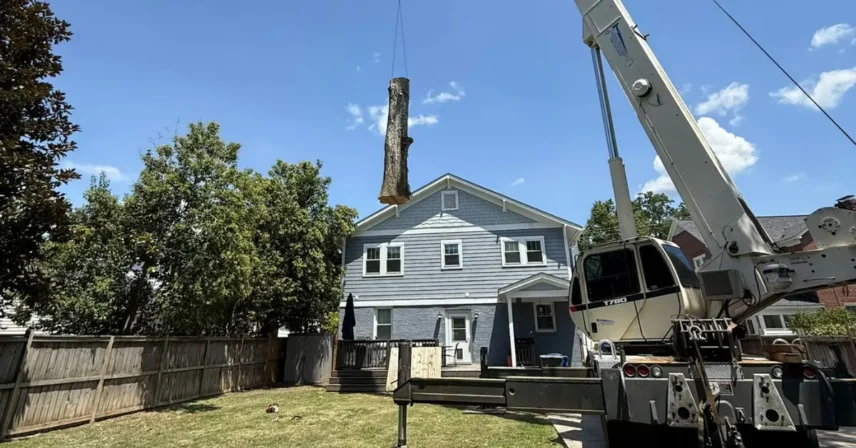
- Crane work. When a crane is needed- usually for hazardous trees, trees too damaged to climb, or trees in tight spaces- it adds $800 to $2,500+ to the job. Often saves money overall by reducing total job time and risk.
- Power lines. Trees near energized power lines need extra care, and sometimes coordination with the utility company. Add 25 to 50%.
- Tree species and trunk diameter. Two trees of the same height can be different jobs. A 60-foot oak with a 36-inch trunk takes far longer to take apart than a 60-foot loblolly with a 14-inch trunk. Hardwoods are heavier, denser, and harder on equipment.
- Tree condition. Dead or rotting trees are more expensive to remove than healthy ones- the wood is unpredictable, sections can fail under the climber’s weight, and the whole job carries more risk. Add 25 to 50% for hazardous removals.
- Stump grinding. At Dixon Trees, stump grinding is included with every removal at no extra charge. Some other companies quote it separately at $100 to $400 per stump.
- Cleanup and haul-off. Standard with every Dixon removal. With some companies, full cleanup is extra- confirm what’s included before you sign anything.
Emergency vs. Scheduled Pricing
Same tree, different timing, different price. Calling for an emergency removal- meaning you need a crew on-site within hours, not days- runs more than scheduling the same job a week or two out. After-hours, weekend, and immediate-response work all carry a premium across the industry, typically 25 to 50% above standard rates.
If a tree fell on your house during a storm, that’s an emergency- no choice about it. But if you’ve got a tree that needs to come down and it’s not actively dangerous, scheduling a few weeks out usually saves money.
Cheapest Months for Tree Removal
Tree work is seasonal. Late winter- January through early March- is the cheapest time to schedule a non-urgent removal. Demand is low, crews have flexibility in the schedule, and the weather is generally cooperative. Spring and early summer get busy. Late summer and fall are usually the busiest and most expensive, especially after storm events when crews are working long days handling damage.
If you can plan ahead and book in winter, you’ll usually pay less.
Multiple Trees at Once Saves Money
Per-tree cost usually drops when several trees are being removed on the same visit. A crew that’s already on your property- set up, equipment running, cleanup crew ready- can do the second and third tree much more efficiently than mobilizing for one. If you’ve got more than one tree that needs to come down, get a bundled quote. Savings are real, usually 10 to 25% per tree on the additional trees.
What Should Be Included in a Real Estimate
A legitimate written tree removal estimate should clearly cover:
- Which specific trees are being removed (described by location on the property).
- The removal method (fell, sectional, crane).
- Whether stump grinding is included or extra.
- What happens to the wood- hauled off or left.
- Full cleanup scope.
- Total price as a firm, written number.
- Proof of insurance available on request.
If a quote doesn’t cover those points, ask. If a company won’t put the price in writing, that’s a red flag and you should call someone else.
Pricing Red Flags
- Suspiciously low quotes. If two companies quote a job at $2,400 and a third comes in at $900, something’s wrong. Usually it means the cheap company is uninsured, the quote doesn’t include what you think it does, or the price will magically climb during the work. Cheap tree work is often the most expensive in the end.
- Storm door-knockers. After every major Midlands storm, traveling crews show up offering cheap immediate cleanup. Many are uninsured and unlicensed and disappear if anything goes wrong. Always verify insurance before hiring anyone you didn’t call.
- Large up-front cash deposits. A small deposit on a big job to hold the schedule is normal. Asking for 50% or more in cash before any work happens isn’t.
- No proof of insurance. A real tree company will provide a current certificate of insurance on request. If they resist or hedge, hire someone else.
- Pressure to decide on the spot. Legitimate quotes don’t have a 24-hour expiration. If a salesperson is pushing you to sign before they leave the driveway, that’s the wrong company.
How Dixon Trees Prices Removals
Every estimate is based on a real walk-through of your property. Our arborists look at the tree, check access, evaluate the surroundings, identify any structural concerns, and give you a single written number that covers the whole job- removal, stump grinding, brush chipping, debris haul-off, and final cleanup.
Our no-surprise guarantee means the quote is the price you pay. If we hit something unexpected once work starts, that’s our problem to solve. New customers get 10% off any service over $500, or $100 off same-day hires. Military and senior discounts available, and we offer financing and payment plans for larger projects.
Get a Quote
If you’ve got a tree that needs to come down in Lexington or the surrounding Midlands, call (803) 598-3888 for a free estimate. In-person, virtual, and phone quotes available. No deposit to get a number, no pressure to book.
Dixon Trees LLC • 165 Governors Grant Blvd, Lexington, SC 29072 • (803) 598-3888 • 24/7 emergency line.