Key Takeaways
- Large willow oaks can develop weak branch unions, heavy limbs, and uneven canopies that increase failure risk in neighborhood settings.
- Tree cabling helps reduce movement in vulnerable limbs and stems, which can lower the chance of sudden breakage during storms.
- Columbia’s thunderstorms, heat, and saturated soils can put extra stress on mature willow oaks.
- Cabling works best when combined with proper pruning, inspections, and sound arborist judgment.
- Professional installation matters because the wrong hardware, placement, or timing can make a tree more dangerous instead of safer.
Across Columbia, South Carolina, large willow oaks are valued for the shade, character, and classic neighborhood look they provide. These trees often anchor older streets, large residential lots, and established yards throughout the Midlands. But their size also brings risk, especially when age, storm exposure, and structural defects begin to take a toll.
Willow oaks are strong landscape trees, but no mature tree is immune to failure. Heavy limbs, competing stems, and long lateral branches can create weak points that become more likely to split under pressure. In a city where summer storms, saturated soils, and high winds are part of the reality, that structural weakness matters.
Tree cabling is one tool arborists use to help reduce that risk. By supporting vulnerable limbs or stems, cabling can help a valuable tree stay standing longer while lowering the chance of sudden failure. It is not a cure-all, but in the right situation it can make a meaningful difference.
Why Willow Oaks Need Support
Willow oaks are admired for their broad canopies and graceful form, but that same structure can create mechanical stress as the tree matures. Long limbs act like levers, and the farther they extend from the trunk, the more force they place on the attachment point. Over time, repeated wind movement can weaken those points.
In many neighborhood settings, willow oaks grow close to homes, sidewalks, driveways, and parked cars. That means a failed limb does more than damage the tree itself. It can damage property, block access, or create a hazard for people walking below.
Mature willow oaks may also develop co-dominant stems, where two main trunks or large branches compete for dominance. These unions are often weaker than a single strong central leader. When storms hit, those weak points are often where the failure starts.
What Tree Cabling Does
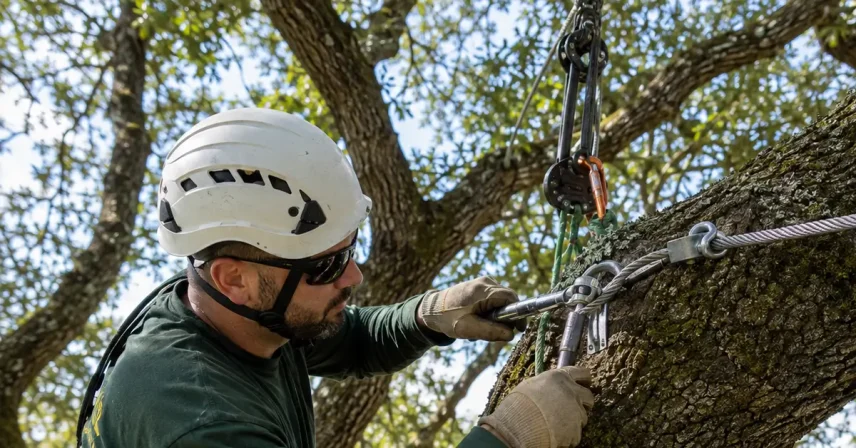
Tree cabling adds supplemental support to vulnerable parts of a tree. It is used to limit excessive movement in heavy limbs or weak unions so the tree can better withstand wind and other loading. In practical terms, it helps redistribute stress rather than allowing one weak point to absorb everything.
Cabling is often paired with pruning to improve the tree’s overall structure. If a tree has too much weight in one direction, pruning can reduce the load while cables provide backup support. Together, those services can lower the risk of failure more effectively than either one alone. According to the Tree Care Industry Association, ANSI A300 Part 3 covers supplemental support systems such as cabling, bracing, and guying, and those standards are used to guide professional installation and maintenance. That matters because the system must be designed for the tree’s specific size, condition, and risk profile.
Columbia Weather Stress
Columbia’s climate puts a lot of pressure on mature trees. The region is known for intense summer thunderstorms, heavy rain, hot humid conditions, and occasional tropical remnants that can bring strong wind and saturated soil. Those conditions can expose weak branch unions quickly. When soil becomes soft, a tree’s root anchorage can be reduced. At the same time, strong winds push against a broad canopy, increasing leverage on heavy limbs and splits. A willow oak that looked stable in calm weather may reveal its weakness in one bad storm.
Heat and drought can also stress trees over time, especially when they are already dealing with age-related decline or canopy imbalance. Stressed trees may not fail immediately, but their internal reserve is reduced. That is why support systems are best considered before the tree is in crisis.
When Cabling Helps Most
Cabling is most useful when a tree has value worth preserving and the defect can be managed rather than eliminated. A healthy or mostly healthy willow oak with a weak union may be a good candidate. So may a tree with large horizontal limbs that overextend over a house or driveway. It can also help when a neighborhood tree has sentimental, ecological, or shade value that homeowners want to preserve. In older Columbia neighborhoods, removing a mature willow oak can dramatically change the look and comfort of a property. Cabling may preserve that canopy while reducing risk.
Despite its numerous merits, cabling is not appropriate for every tree. If the root system is badly compromised, if decay is too advanced, or if the tree’s structure is beyond repair, removal may be the safer choice. A professional arborist in Columbia, SC has to make that call based on the full picture, not just the visible canopy.
Tree cabling is only effective when it is installed correctly. The hardware, attachment points, and cable type all need to match the tree’s structure and load requirements. Poor placement can create new wounds or fail to support the part of the tree that actually needs help. The purpose of support systems is to reduce the risk of mechanical failure to an acceptable level, not to make a tree indestructible. Even a well-cabled tree still needs monitoring because growth, decay, and storm damage can change the situation over time.
Professionals also know when cabling is not the right answer. If pruning or removal is safer, that should be recommended instead. The best tree-care plans are honest about limits, not just focused on keeping every tree at all costs.
Signs A Willow Oak May Need Cabling
Homeowners should pay close attention to large limbs that split into two major stems or show visible cracks at the union.
- Weak Branch Unions: Multiple trunks or co-dominant stems with weak branch attachments.
- Visible Cracks: Splitting or cracks where large limbs join the trunk.
- Overextended Limbs: Long, heavy branches hanging over homes, driveways, sidewalks, or other high-value targets.
- Excessive Limb Movement: Branches that sway excessively or rub against each other during windy conditions.
- Uneven Canopy Weight: A lopsided or heavily weighted canopy placing extra stress on major limbs.
- Past Storm Damage: Previous limb failures or storm damage that may increase the risk of future branch failure.
- Professional Assessment: An arborist identifies structural weaknesses that can be improved with a properly installed cabling system.
Neighborhood Benefits
For homeowners, cabling can be a practical way to protect a high-value tree without removing it. That matters in neighborhoods where mature willow oaks contribute to curb appeal, shade, and property value. A supported tree can continue serving the landscape while reducing immediate risk.
- Cabling can also help reduce the chance of storm cleanup after major wind events.
- Fewer split limbs and fewer sudden failures mean less debris, less emergency work, and less damage to nearby structures. That can save money in the long run.
- There is also a safety benefit that goes beyond property damage. Large tree failures can block driveways, trap vehicles, and create hazardous cleanup conditions. Preventive support is often much easier than responding after a limb comes down.
How Arborists Evaluate Trees
A professional arborist begins by looking at structure, decay, stem attachment, and canopy balance. They also consider how close the tree is to homes, streets, fences, and other targets. The goal is to estimate both the likelihood of failure and the consequences if failure occurs.
In some cases, the best solution is a combination of pruning and cabling. In other cases, the tree may have too much decay or too much structural damage for support systems to work safely. That is where expert judgment matters most.
Dixon Trees lists tree pruning, tree trimming, tree removal, and lot clearing alongside cabling and bracing, which gives homeowners options based on actual tree condition rather than a one-size-fits-all approach. That flexibility is important in older Columbia neighborhoods where mature willow oaks vary widely in health and risk.
Frequently Asked Questions About Willow Oak Cabling in Columbia, SC
What is the main purpose of tree cabling?
Tree cabling is used to support weak branches or stems and reduce movement that could lead to failure. It helps lower risk, but it does not eliminate it entirely.
Can cabling save a willow oak that is already damaged in Columbia, South Carolina?
Sometimes, but only if the tree still has enough structural integrity to support the system. Trees with severe decay or root failure may be better candidates for removal.
Does cabling replace pruning?
No. Cabling often works best with pruning because reducing weight can improve how the support system performs. A combined approach is often more effective than support alone.
How long does a cabled tree last?
That depends on the tree’s condition, growth rate, and ongoing maintenance. Support systems need periodic inspection because the tree changes over time.
Should every large willow oak be cabled?
No. Cabling should be based on risk, structure, and tree value. Many healthy trees do not need it, while some high-risk trees may need removal instead.
Summary Checklist: Willow Oak Cabling and Maintenance Checklist
| Task | Priority | Recommended Action |
| Inspect mature willow oaks | High | Look for cracks, heavy limbs, and weak unions |
| Reduce excess weight | High | Use professional pruning to lower stress |
| Evaluate support options | Critical | Ask whether cabling is appropriate for the tree |
| Monitor storm-prone trees | High | Recheck after major wind or rain events |
| Protect nearby targets | Critical | Focus on trees over homes, driveways, and sidewalks |
| Schedule routine follow-up | Moderate | Reinspect cables and tree condition over time |
Final Advice
Large willow oaks add beauty and value to neighborhoods, but they require proper care and regular structural evaluations. If a tree has a weak union or signs of stress, cabling may help reduce the risk of limb or stem failure before severe weather arrives. The best approach is to address potential problems early rather than waiting for cracks, decay, or major branch loss to appear.
Always rely on a professional arborist inspection to determine whether cabling, pruning, monitoring, or removal is the right solution for your tree. Cabled trees should also be inspected periodically, as growth, storms, and changing conditions can affect their support needs over time. For trees located near homes, driveways, or sidewalks, taking action early is especially important to reduce safety risks.