Key Takeaways
- “Crape murder” cutting crape myrtles back to stubs every winter is a widespread but genuinely harmful pruning practice that weakens the tree over time rather than helping it.
- Topping forces weak, whip-like regrowth that’s more prone to breaking in storms, and it eventually leads to unsightly knuckles and a shorter-lived tree.
- Correct crape myrtle pruning follows ANSI A300 structural principles: selective thinning, removing crossing or inward-growing branches, and preserving the tree’s natural vase shape.
- Late winter, while the tree is dormant, is the right window for pruning in the Midlands, not a hard reset of the entire canopy every year.
- Most mature, well-placed crape myrtles need very little pruning at all beyond removing suckers, crossing limbs, and spent seed heads.
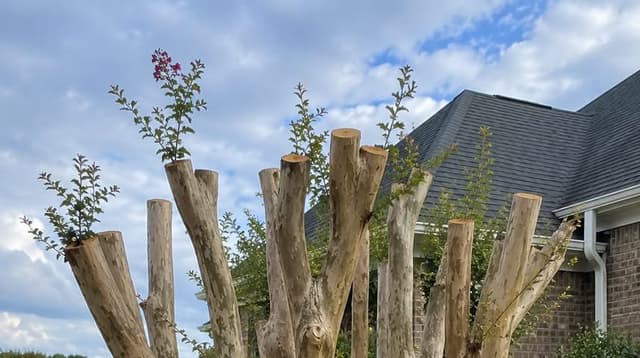
Drive through almost any neighborhood in Lexington or the Greater Columbia area in late winter and you’ll see it: crape myrtles chopped down to thick, stubby trunks, every branch cut flat at roughly the same height, like a row of amputated fists reaching up from the yard. It’s such a common sight across the Midlands that a lot of homeowners assume it’s just how crape myrtles are supposed to be maintained. It isn’t. Arborists have a name for this practice “crape murder” and while it rarely kills the tree outright, it does real, cumulative damage that shows up over years, not seasons.
Here’s what’s actually happening when a crape myrtle gets topped, why it’s such a persistent habit in South Carolina landscaping, and how to prune these trees the way they’re supposed to be pruned.
Why Incorrect Crape Pruning Became So Common
Crape myrtles are naturally vigorous growers, and topping them does produce a fast, visually dramatic result: within a single growing season, a hacked-back tree explodes with new growth and, often, a heavier bloom than the year before. That immediate payoff is a big part of why the practice spread; it looks like it’s “working,” especially to homeowners and landscape crews who don’t see what’s happening below the surface. There’s also a sizing problem behind a lot of crape murder. Many crape myrtles get planted without much thought to their mature size tucked under power lines, jammed against a house, or squeezed into a bed that’s too small for a tree that naturally wants to grow 15 to 25 feet tall. Topping becomes the annual “solution” to a tree that was simply planted in the wrong spot to begin with.
What Topping Actually Does to the Tree
Tree topping may make a crape myrtle look neat for a short time, but the effects can cause problems as the tree grows back. The new branches may be weaker, more crowded, and more likely to break during storms. Over time, repeated topping can also change the tree’s natural shape and create long-term damage.
Here is what Topping does to the tree –
Causes Weak New Growth
When a crape myrtle is cut back hard every year, it quickly grows several new shoots from each cut. These shoots often grow straight up and can be thin and weak. Because they grow quickly after the tree loses much of its canopy, they may not have strong connections to the main branches. Over time, this can leave the tree with a lot of weak new growth instead of a strong, healthy branch structure.
Makes the Tree More Likely to Break
Weak shoots are more likely to snap during strong winds and storms. This can be a bigger concern during the summer thunderstorms and tropical weather that can affect the Midlands. After years of topping, the tree may have a heavy amount of growth at the top supported by thin branches. This can increase the chance of broken limbs and storm damage.
Creates Large Knuckles on the Branches
Cutting the same branches back to the same spots year after year can create large, swollen areas called “knuckles.” These areas can become damaged and may provide places for decay and disease to enter. The knuckles also change the tree’s natural shape and can leave permanent marks on the branches. Even if the topping stops, these areas may remain visible for the rest of the tree’s life.
Affect the Quality of the Blooms
Topped crape myrtles may produce a lot of flowers, but that does not always mean the tree is healthier. Large flower clusters can become heavy on thin new branches. After rain, these branches may bend or droop under the extra weight. Proper pruning helps the tree develop stronger branches that can better support its flowers.
What Correct Crape Myrtle Pruning Actually Looks Like
Real crape myrtle pruning follows the same structural pruning principles ANSI A300 standards that apply to any tree: work with the tree’s natural form instead of against it, and prune to improve structure rather than to force size control through repeated hard cuts.
In practice, that means:
- Selective thinning rather than topping: Instead of cutting every branch flat at the same height, remove select branches back to a lateral branch or the trunk, opening up the canopy without stripping it wholesale.
- Removing crossing, rubbing, or inward-growing branches: These create wounds where they contact each other and crowd the canopy’s interior, so removing them improves airflow and reduces disease pressure.
- Clearing suckers and root sprouts: Crape myrtles often send up thin shoots from the base of the trunk or the root zone. These add nothing structurally and are worth removing regularly.
- Removing spent seed pods selectively: Some homeowners like to snip off the previous season’s seed heads for appearance, which is fine in moderation, but this is cosmetic; it isn’t the same as, and shouldn’t turn into, cutting back live wood.
- Preserving the natural vase shape: A well-maintained mature crape myrtle has a graceful, multi-trunk, vase-like form with an open interior canopy. Good pruning maintains and enhances that shape over years rather than resetting it to stubs annually.
For a mature, well-placed crape myrtle, this kind of maintenance pruning is a light annual touch, not a major undertaking, often 20 to 30 minutes of selective cuts rather than an hour of indiscriminate cutting with loppers and a chainsaw.
Timing Matters
- Late winter typically January through early March in the Midlands, while the tree is still fully dormant and before new growth starts is the right window for crape myrtle pruning.
- Pruning during this dormant period lets the tree heal and push new growth in spring without the stress of losing live, leafed-out wood during the growing season.
- Pruning too late, once new growth has already emerged, sets the tree back and can reduce that season’s bloom.
Why This Matters Beyond Aesthetics
Crape murder isn’t just a cosmetic issue, even though the disfigured “fist” look is what usually catches people’s attention. It’s a structural pruning problem that leaves trees with weaker wood, more storm vulnerability, and permanent trunk damage, the kind of thing that shows up as broken limbs in your yard after the next Midlands thunderstorm rolls through. Pruning correctly, on the right schedule, with the tree’s natural structure in mind, produces a healthier tree, a better bloom, and less storm damage down the road.
Dixon Trees LLC provides professional crape myrtle pruning in Lexington, Columbia, and the Midlands. Our ISA-trained arborists follow ANSI A300 standards and avoid topping, focusing instead on healthy growth and natural structure. We bring over 50 years of combined experience to every job. For homeowners in Columbia, Springdale, Gilbert, Leesville, Andrews, SC and Lexington and surrounding Midlands communities, proper pruning can protect the investment you’ve already made in your landscape.
Frequently Asked Questions About Crape Myrtle Pruning by the Homeowners in South Carolina
Will topping eventually kill my crape myrtle?
Rarely outright, since crape myrtles are resilient growers, but repeated topping weakens the tree’s structure over time, creates decay-prone knuckles, and shortens its functional lifespan compared to a properly pruned tree.
When is the best time to prune crape myrtles in Columbia and Lexington?
Late winter, while the tree is dormant generally January through early March before new spring growth begins.
Can I fix a crape myrtle that’s already been topped for years?
Yes, gradually. Selecting and keeping the strongest shoots at each cut point while removing the rest, over a couple of seasons, can rebuild a more natural structure over time.
Do crape myrtles actually need to be pruned every year?
A mature, well-placed crape myrtle needs only light annual maintenance removing crossing branches, suckers, and any storm damage, not a hard cutback.
What size crape myrtle should I plant if I don’t want to prune it heavily?
Dwarf and semi-dwarf varieties, which mature well under 10 feet, are a better fit for tight spaces than full-size varieties, and they eliminate most of the reason people start topping in the first place.
Summary Checklist: Proper Crape Myrtle Pruning
| Situation | What to Check | What to Do |
| Tree has been topped in past years | Weak regrowth and knuckling | Gradual restoration pruning over multiple seasons |
| Crossing or rubbing branches | Interior canopy crowding | Remove to a lateral branch or trunk |
| Suckers at the base | Unwanted root growth | Remove during dormant season pruning |
| Tree outgrowing its space | Mismatched mature size for the site | Consider removal and replacement with a smaller variety |
| Planning first-time pruning | Dormant season timing | Schedule for late winter, before spring growth |
Final Advice
Crape myrtles can be beautiful, long-lasting additions to Midlands landscapes when they are pruned with their natural structure in mind. Avoiding hard topping helps preserve stronger branches, a healthier canopy, and the tree’s natural shape.
If your crape myrtles have been topped for years, they may still benefit from gradual restoration pruning rather than another severe cutback. The right approach depends on the tree’s age, condition, size, and planting location.
Dixon Trees LLC – an ISA-trained arborist in Lexington, South Carolina can identify weak growth, crossing branches, excessive knuckling, and other structural concerns before they become bigger problems. Professional pruning can also help reduce unnecessary stress and improve the tree’s appearance.