Key Takeaways
- Lexington’s heavy clay soil can make large tree removals more unstable and unpredictable.
- Wet clay leads to sinking equipment, poor footing, and avoidable yard damage.
- Trees grown in clay often develop shallow, wide-spreading root systems instead of deep anchoring roots.
- Large removals frequently call for rigging, sectional dismantling, or crane support.
- Working with a crew that understands Lexington and Midlands soil conditions matters more than most homeowners realize.
When most homeowners in Lexington start thinking about removing a large tree, their attention goes straight to the tree itselfits height, the width of the trunk, or how close the canopy sits to the roofline. What rarely crosses their mind is what’s happening underground. In this part of South Carolina, dense clay soil can turn what looks like a routine removal into a far more technical and demanding project.
Clay changes nearly every part of the job. It shapes –
- how roots develop
- how stable a tree actually is
- how heavy equipment can move across the property, and
- how much cleanup will be needed once the work is done.
A removal that seems straightforward from the driveway can look completely different once a crew is standing under the tree with chainsaws running. That’s why large removals in Lexington deserve careful planning, particularly after heavy rain or in yards where drainage has always been a struggle.
6 Ways Clay Soil Changes the Equation
Clay behaves very differently from the sandy or loamy soils found in other parts of the country.
- Moisture Retention: Clay soil holds water much longer than sandy or loamy soils, leaving the ground soft and unstable for days after rainfall.
- Dry-Hard Surface: During dry periods, clay becomes hard and compacted, making excavation and equipment setup more difficult.
- Worksite Challenges: Constant shifts between wet and dry conditions create safety and operational challenges for tree removal crews.
- Shallow Rooting: Trees in heavy clay develop wide, shallow root systems because oxygen is more available near the surface.
- Reduced Stability: Shallow roots provide less anchorage, making large trees more susceptible to leaning or failure.
- Saturated Soil Risk: Prolonged wet conditions further weaken root support, increasing the complexity and risk of large tree removals.
The Underground Risks You Can’t See
The visible part of a tree only tells part of the story. Below the surface, clay soil can be hiding root problems that never show themselves above ground.
- Saturated Soil: Saturated soil and waterlogged clay gradually weakens the structural support provided by tree roots.
- Compacted Ground: Dense clay restricts healthy root growth and long-term tree stability.
- False Appearance: A tree may appear healthy while standing on a compromised root system.
- Shifting Balance: Removing limbs changes the tree’s centre of gravity throughout the process.
- Unpredictable Movement: Weak roots can cause the remaining trunk to shift unexpectedly during removal.
- Property Risk: Sudden movement increases the risk of damage to nearby homes, fences, landscaping, and workers.
Why Size Makes Everything Harder
The larger the tree, the more force is involved at every stage of removal.
- Base Stress: Heavy trunks and oversized limbs place significant pressure on the tree’s base during removal. On clay soil, this stress can quickly expose hidden stability problems.
- Soil Stability: Wet or shifting clay does not provide the same support as firm, well-drained soil. Trees may react unpredictably as weight is removed.
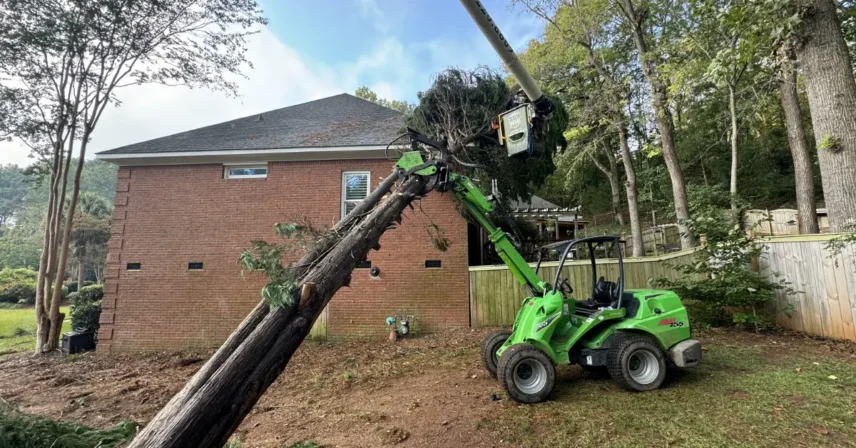
- Equipment Access: Large tree removals require space for cranes, rigging systems, and debris. Tight work areas become even more challenging on soft clay.
- Ground Damage: Heavy equipment can leave deep ruts or sink into saturated clay after rain. This increases cleanup needs and may limit equipment access.
- Controlled Rigging: Experienced crews often remove large trees in carefully controlled sections. Rigging helps manage changing loads and improves safety.
- Property Protection: Piece-by-piece removal reduces the risk of damage to lawns, driveways, fences, and nearby structures. It also provides greater control throughout the project.
Equipment and Access Problems Clay Soil Creates
Access issues can show up before a single cut is even made. Trucks, chippers, stump grinders, and other heavy equipment all need stable ground to operate safely. If the yard is wet from recent rain, those machines can sink into the turf, slide unexpectedly, or tear up the lawn just getting into position. That slows the entire job down and can add unexpected cost if the crew has to work around poor footing or bring in additional equipment. This is where careful planning pays off. Sectional dismantling removing the tree in smaller, controlled pieces rather than large falling sections reduces the impact on the ground and lowers the risk of equipment getting bogged down. For trees that are especially large, unsafe to climb, or positioned too close to the home, crane-assisted removal can be the safer option, giving the crew more precision and helping keep the surrounding property intact.
Knowing When Removal Is Actually Necessary
Not every tree growing in clay soil needs to come down. Many trees can be preserved with the right pruning, structural cabling, or improved drainage around the root zone. But there are warning signs that shouldn’t be brushed aside. A cracked trunk, a visible lean that wasn’t there before, exposed roots, fungal growth at the base, hollow sections, or recent storm damage can all point to a tree that’s heading toward failure.
Clay soil tends to make these problems progress faster and hide them longer. When the ground stays wet for extended stretches, the root zone can already be under serious stress before the tree shows any obvious symptoms above ground. Waiting too long to address these signs increases the risk of sudden, unexpected failureparticularly during the strong storms that roll through the Midlands each year. A professional on-site evaluation remains the most reliable way to determine whether a tree needs to come down, be pruned back, or simply monitored over time.
Lexington and the surrounding Midlands present their own combination of challenges such as – dense clay soil, intense summer storms, strong seasonal winds, and a landscape full of large, mature trees. A dedicated tree service firm in Lexington, South Carolina that works in this area regularly understands how the ground behaves through wet and dry cycles and how that behavior affects every stage of a removal. That kind of hands-on, local knowledge can make a meaningful difference on a technically demanding project.
Dixon Trees is based in Lexington and serves homeowners throughout the Midlands with tree removal, trimming, pruning, cabling, and storm cleanup. We use specialized equipment to perform crane-assisted removal for larger or more difficult trees, and provide free estimates before any work begins. For homeowners dealing with a large tree in clay soil, that combination of local familiarity and proper equipment can mean the difference between a smooth removal and a costly mistake.
Frequently Asked Questions About Tree Removal in Lexington Clay Soil by Homeowners in Lexington, SC
Can clay soil make a tree fall sooner than expected in Lexington, SC?
Yes. Clay can retain excess water for long stretches, and that saturation can gradually weaken the root support a tree depends on.
Is tree removal harder after it rains?
Almost always. Wet clay becomes slippery underfoot and makes both crew footing and equipment access more difficult.
Can a tree in clay soil be saved instead of removed?
Sometimes. If the tree is still structurally healthy, targeted pruning or cabling may be enough to extend its life safely.
Why do some removals require a crane?
Cranes allow heavy sections to be lifted and lowered with precision, which reduces the chance of damage to the lawn, driveway, or nearby structures.
Should I get a professional inspection before deciding?
Yes. A local, on-site inspection is the most reliable way to figure out the safest and most appropriate removal method for your specific property.
Summary Checklist: Clay Soil Tree Removal in Lexington, KY
| Task | Why It Matters |
| Check the soil condition after rain | Wet clay can make removal work genuinely unsafe |
| Look for signs of root weakness | Compromised roots can change how a tree falls |
| Confirm the right equipment is used | Heavy machines need stable, dry footing |
| Choose a controlled removal method | Sectional work and rigging reduce damage and risk |
| Schedule a local inspection first | Lexington’s clay soil calls for local, hands-on experience |
Final Advice
If you have a large tree growing in clay soil anywhere in Lexington, don’t assume the removal will be simple just because the tree looks stable from where you’re standing. The ground underneath it may be telling an entirely different story. Wet clay, shallow roots, and poor drainage can all combine to make the job far more complicated than it first appears.
The safest first step is scheduling an on-site evaluation. A professional can assess the tree itself, examine the root zone, and check the access points around your property before any cutting begins. That assessment is what determines whether the tree should be removed right away, pruned and monitored, or handled with specialized equipment like a crane.